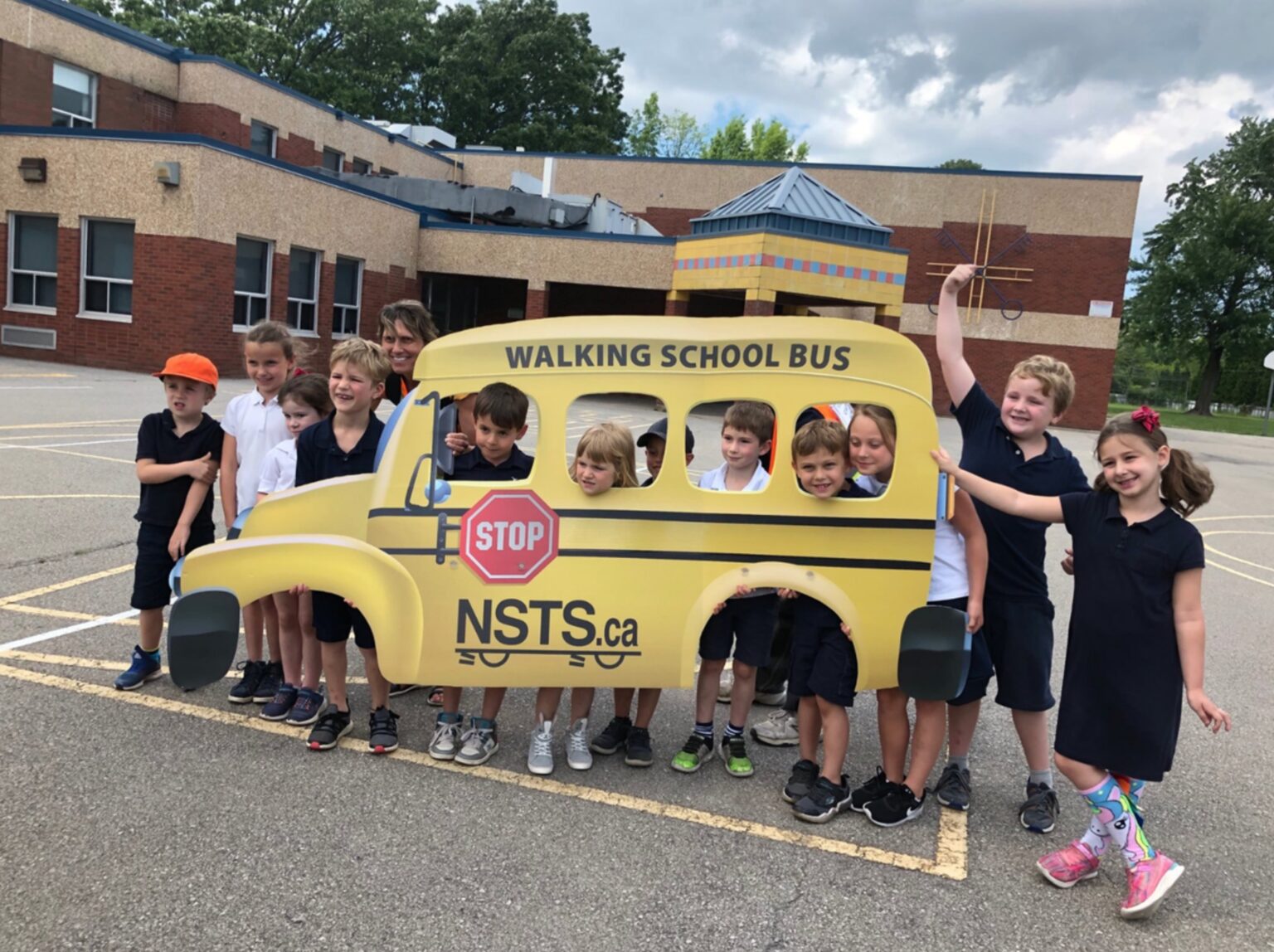
The purpose of this resource is to support the creation of a Walking School Bus program, in order to provide a safe and dependable way for children in Kindergarten through Grade 8 to walk to school.
Description
A Walking School Bus (WSB) is simply a group of children walking together under the supervision of one or more adult leaders following a prescribed route and schedule. Each “bus” picks up children at designated stops along the way to school. Some WSBs operate every day, while others may only run weekly or monthly.
WSBs can help to overcome several important barriers to active travel, such as:
- Parent concerns about allowing their child to walk to school (e.g., too young, lack of time, bullying, or stranger danger);
- Uncontrolled/busy intersections; and
- Traffic volume and speed – walking in groups makes children more visible to drivers and can help calm traffic around schools.
A WSB can be very effective at reducing the number of students living within walking distance who are being driven to school by car. They can help create an important initial shift in habits for some families, and as a highly visible program, they can draw attention to walking for the school journey and help to encourage more change. A WSB can also be offered for a limited period as an effective way to give students ‘on-street’ pedestrian skills training and help them to develop the confidence and ability to walk on their own in the future.
While a WSB has many benefits, it can be challenging for a school community to develop and sustain one as a volunteer-based initiative. A good first step is to contact your school board/district, student transportation authority, municipality, and/or public health unit to find out what help is available in your community for a WSB initiative. If there is none, you should reach out to the principal, school council, and interested parents/caregivers to determine the level of interest in, and capacity to support, a WSB.
As an alternative, a Walking Buddies program is a simpler, less resource-intensive option for supporting students to walk, because it does not involve adult walking leaders.
What you will need
Commitment from a dedicated group of volunteers or staff to plan, schedule, and operate the WSB program.
Who can help
Principals, school councils, parents/caregivers, school board/district, municipality, and local community organizations.
Key words
Walk, pedestrian, traffic, active transportation, school travel, safety, walking, bus.