The Home Retrofit Journey
Wyatt received a flyer in the mail about the $5,000 rebate through the Canada Greener Homes Grant, which got her thinking about her sunny roof. She read more about it and got on the Greener Homes website to find an NRCan-registered energy advisor. “I was looking for somebody who would be from here, rather than someone coming from elsewhere. A list from the Greener Homes website is what led me to Red Squirrel,” Wyatt said.
Sam Carlstrom from Red Squirrel (now merged with Sustainable Kingston) made the first visit to conduct an EnerGuide home energy evaluation on August 24th, 2021. Carlstrom set up the blower door fan test and, during their home walkthrough with Wyatt, checked for air leaks and insulation levels.
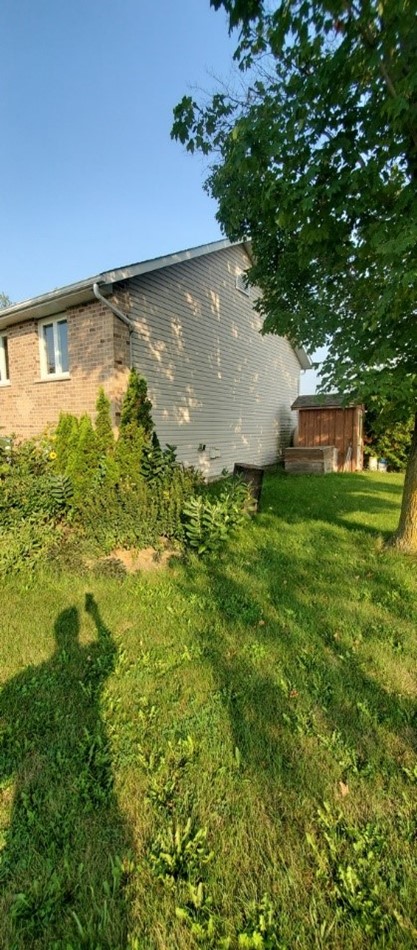
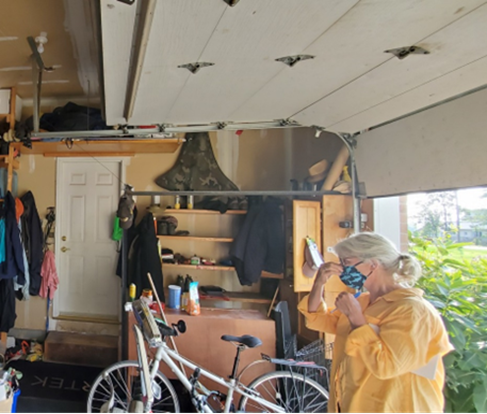
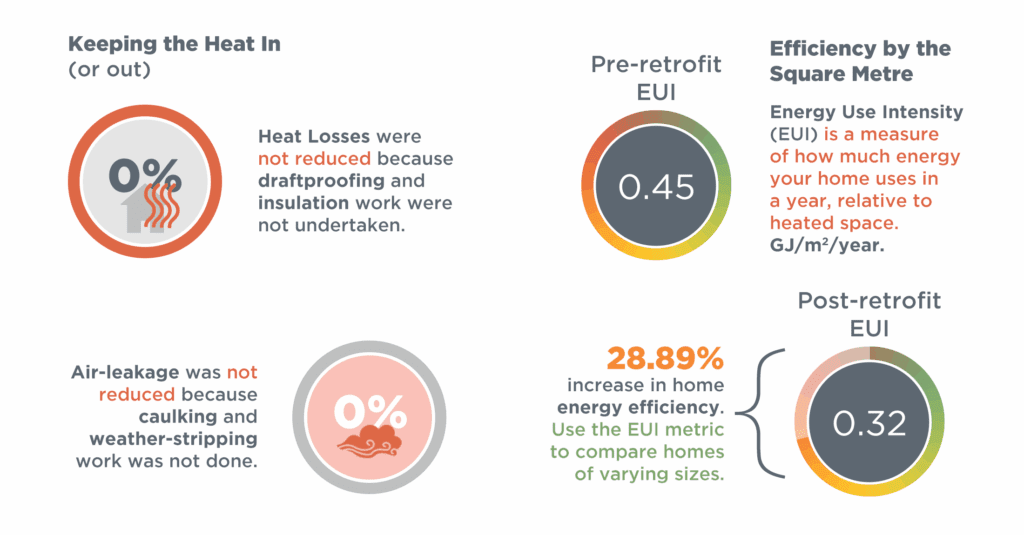
“Sam said that there was one pipe leaving that house that had a gap around it and a room that needed weather-stripping around the door, and that was it.” The homeowner was pleasantly surprised to hear from the advisor that the windows, insulation, and draft-proofing were still quite adequate from when the house was built in 1997.
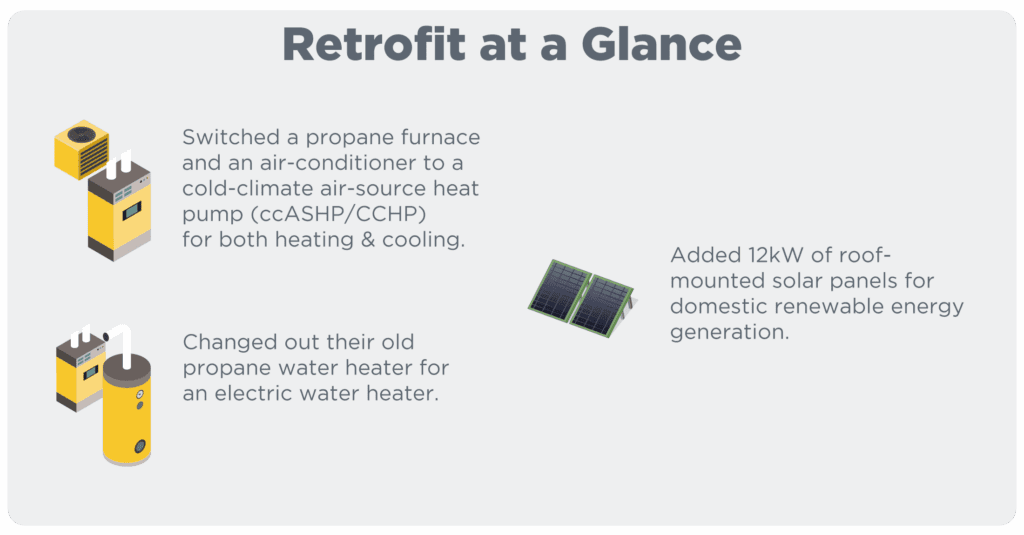
Making the best use of the house’s good insulation and nearly leak-free construction, the couple decided to make use of the federal grant to help subsidize the cost of mechanical upgrades and installation of a solar photovoltaic system to improve their home’s energy efficiency.
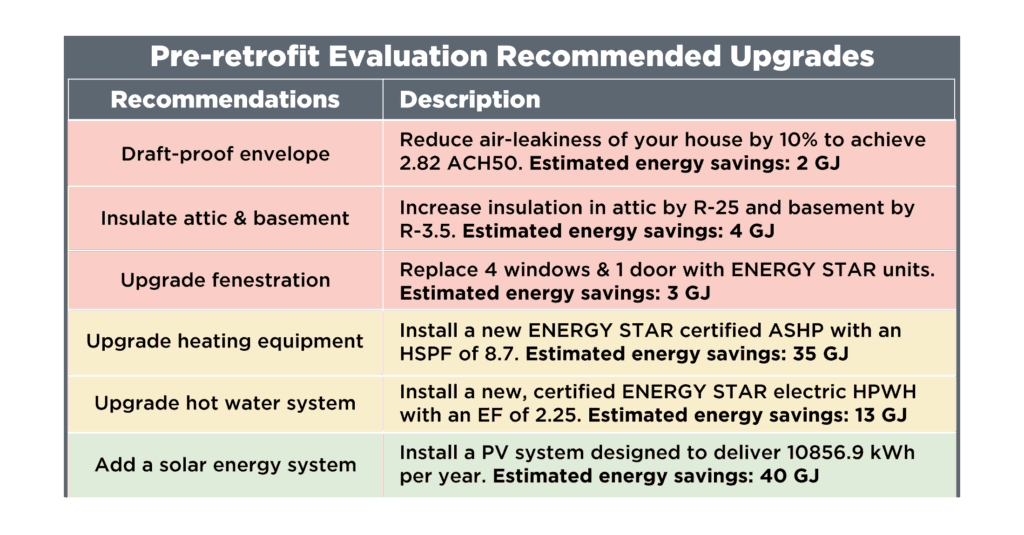
The Deep Energy Retrofit
The first thing Wyatt and Campbell did after the pre-retrofit evaluation was contact Quantum Renewable Energy to talk about adding solar panels to her roof. Campbell’s relatives had previously worked with them before, and Wyatt took up the recommendation.
A representative from Quantum visited their house in August 2021 and did an assessment of the home’s readiness for solar panel installation by first looking at whether the roof could support the added weight. The company rep then informed the couple that an installation could be, at the earliest, scheduled for March 2022.
After the initial inspection, Wyatt sent various energy bills over for Quantum to calculate their household’s annual energy load and reach the right specifications for the couple’s roof-mounted solar panel system.
“Quantum looks at how much electricity you’re using now, and what you expect to use in the future. I told them that we currently have a propane dryer, propane hot water, and a propane furnace, but my intention, eventually, was to switch to electric so they’d be using solar. Another aim, at some point, is that the car would be electric. So, Quantum looked at the prospective plan to account for all the kilowatt usage, where they would then factor it all in and zero it out for net-metering,” Wyatt explained.
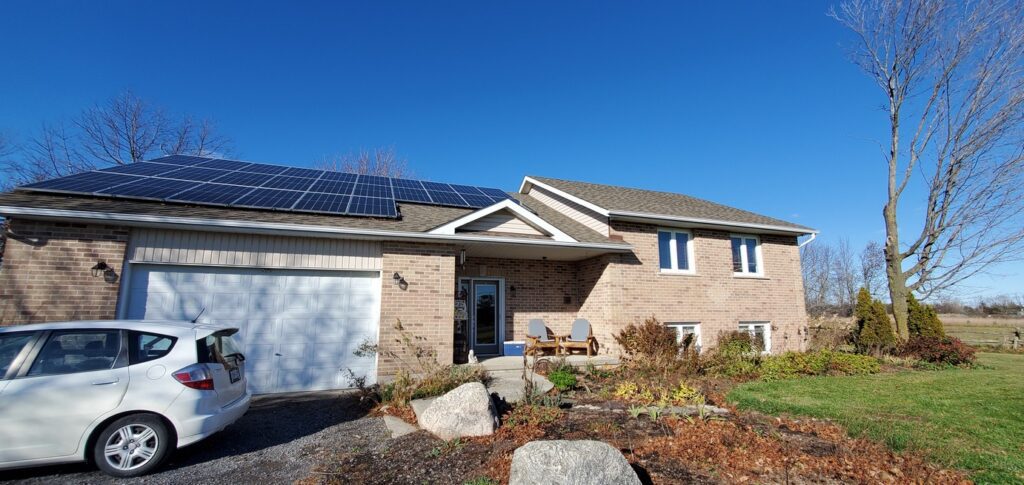
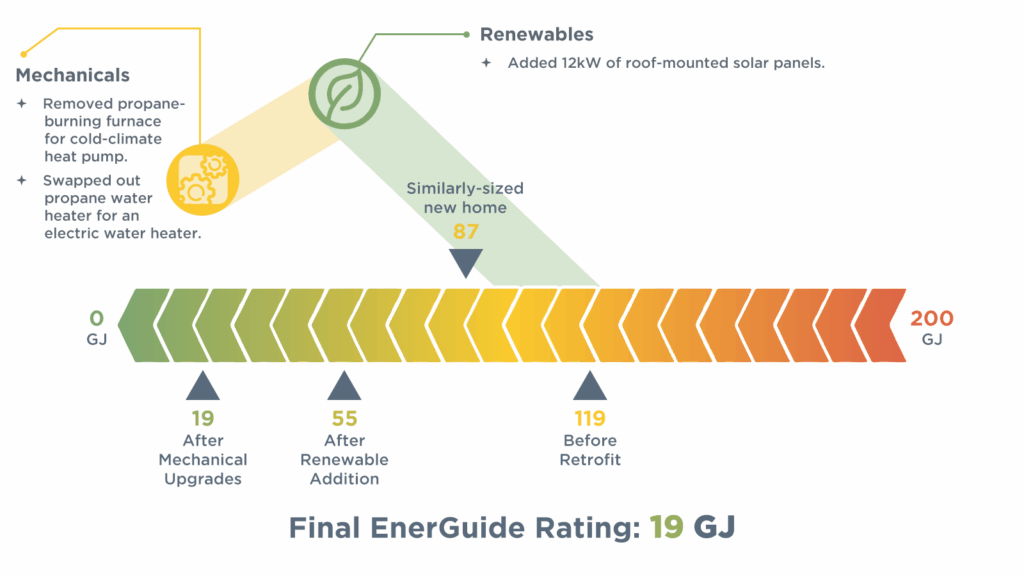
Quantum installed the 12kW solar panels on their sunny roof at the end of March 2022. The net-metering was set up by the utility two months later, in June 2022, because of some delays.
After the solar panels were installed, the couple was able to track solar productivity in real time on the Solar Edge app on their phones.
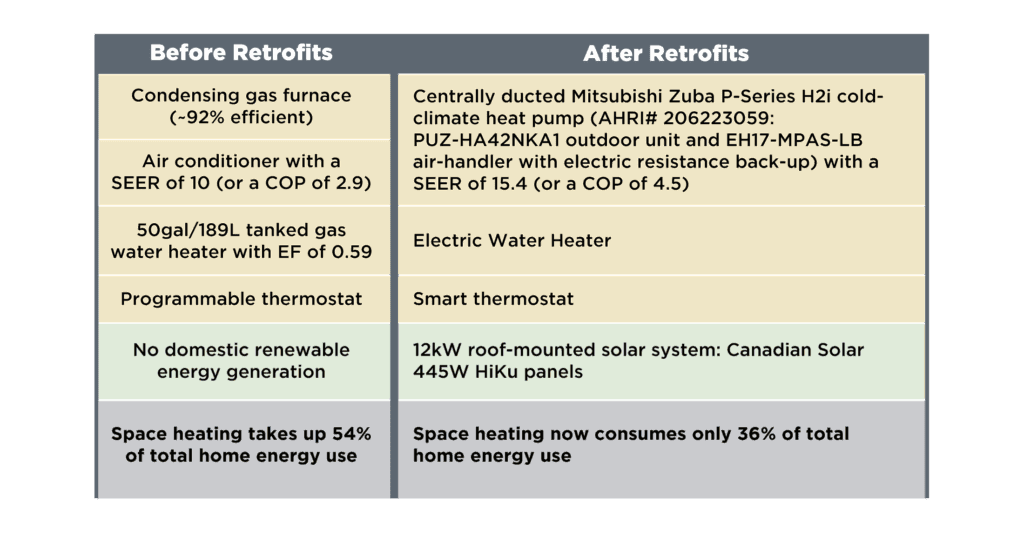
As for swapping out their over 20-year-old propane furnace for a heat pump, the couple was thinking of waiting because the furnace was still working fine. That was the plan until Diana received an inheritance from her father, and they changed their mind.
Wyatt did some research and found out from her sister Eve that Mitsubishi heat pumps are popular in Toronto. The couple faced some challenges finding someone to install the system. But eventually, Wyatt found a small HVAC contractor in Yarker, a small town nearby, who installs Mitsubishi Zuba cold-climate air-source heat pumps.
Although the house didn’t need an electrical panel upgrade to install the heat pump, the wiring from the heat pump to the panel, and from the outdoor to the indoor unit needed improvement. The electrical wiring upgrades cost the couple $1,000, and about half of that was for wiring from the outdoor to the indoor unit.
Wyatt and Campbell also switched to an electric water heater from their propane one. They are yet to switch away from their propane dryer as they’re waiting to get a better sense of how their solar system will cover the electrical load.
The very last thing in the retrofit project was to fix two leaky spots that Red Squirrel identified in the first evaluation, which only took Campbell 20 minutes to complete.
The retrofit project was completed in November 2022.
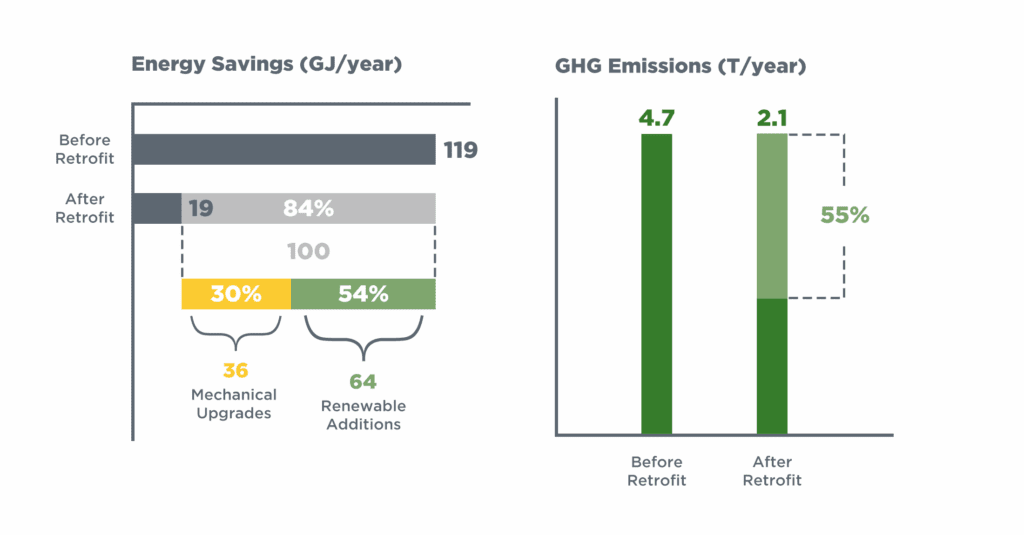
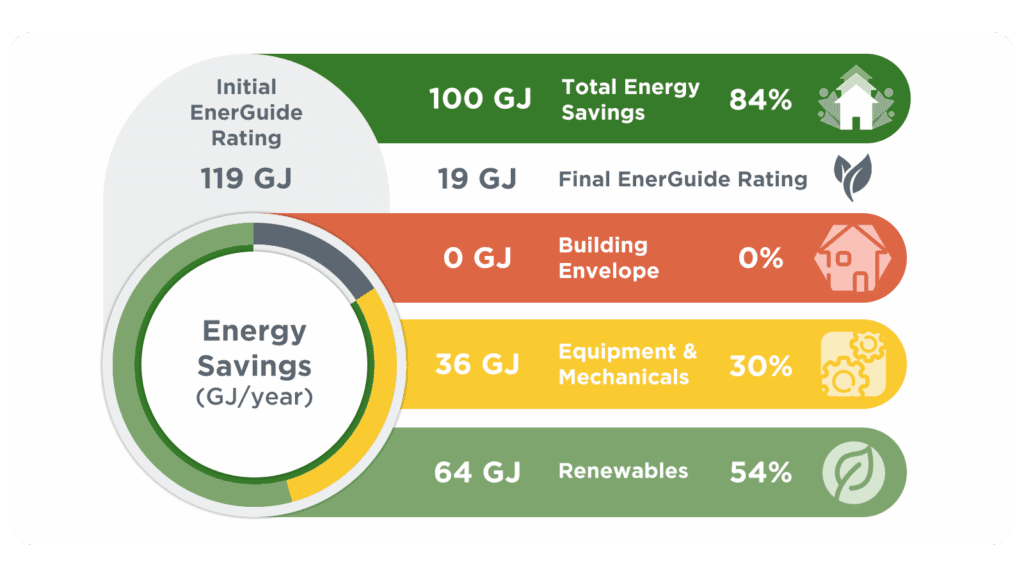
Red Squirrel’s post-retrofit energy evaluation showed the home went from consuming 119 GJ of energy per year — slightly more than a comparable new house’s consumption of 87 GJ — to just 19 GJ a year!
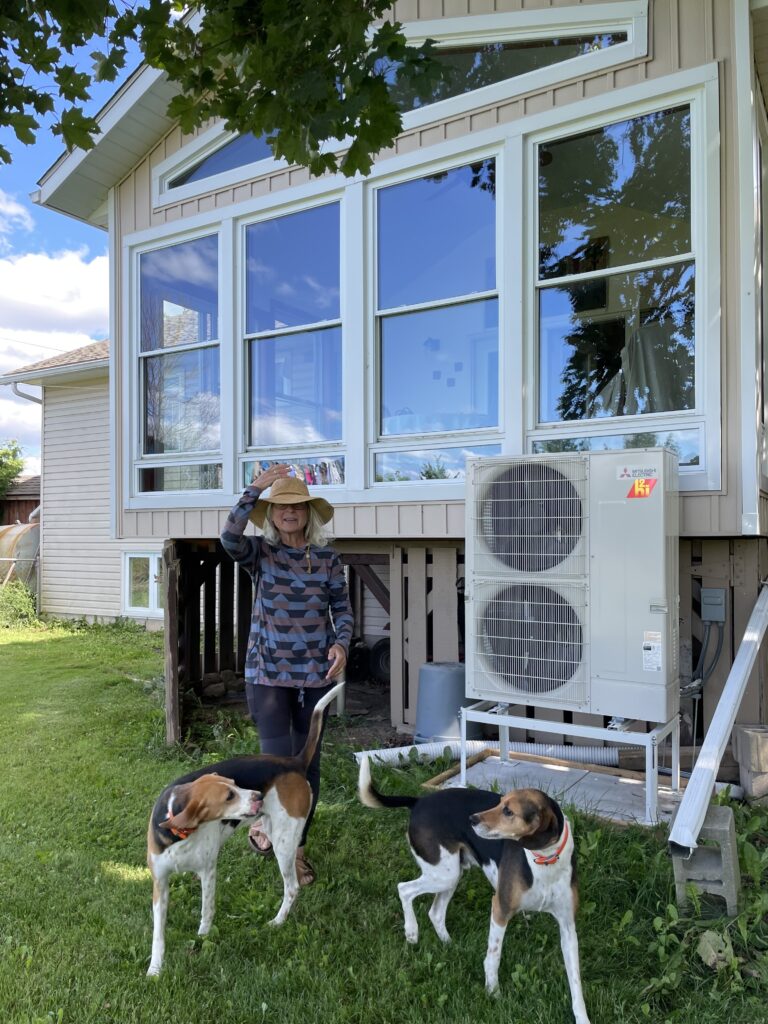
Overall, the retrofit project that started with solar panel installation in June 2022 and heat pump upgrade in August was completed with the last building envelope upgrades in November 2022. Campbell and Wyatt had their final EnerGuide home energy evaluation done in that same month. Red Squirrel sent another energy advisor, equipped with a digital tablet, to conduct the final audit.
Caroline Kirkwood’s post-retrofit energy evaluation showed that after putting in solar panels, switching to a heat pump, changing to an electric water heater, and improving the building envelope, Campbell and Wyatt’s home went from consuming 119 GJ of energy per year — slightly more than a comparable new house’s consumption of 87 GJ — to just 19 GJ a year!
“It was straightforward: they (Registered Energy Advisors) came when they said they would, they were clear on what they were doing and on what they couldn’t do. They were great,” the homeowner said of her experience with the two advisors who evaluated her home.
The Retrofit’s Benefits
After the deep energy retrofit, the residents noticed the air smelled a lot fresher in their home. During the retrofit, contractors removed mouse nests from the propane furnace and air conditioner, which likely resulted in improved indoor air quality.
Another noticeable change was the noise level: the loud roar of the air conditioner fan had been replaced by the quieter whirring of the heat pump fan.
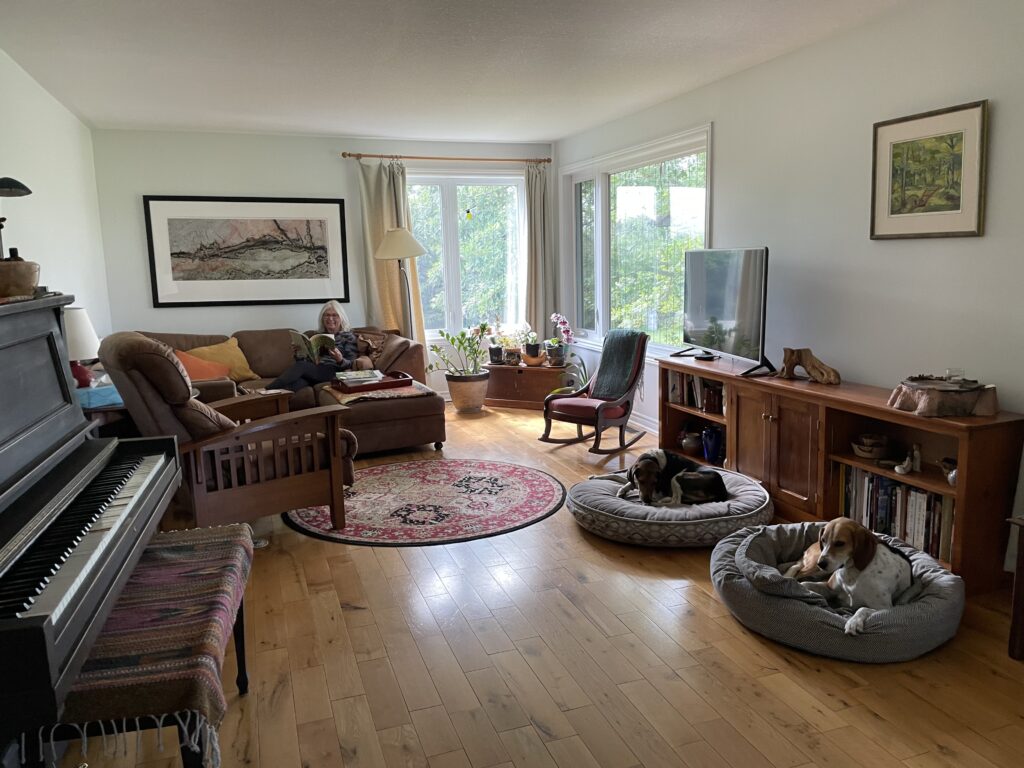
Wyatt also noted that the backup heater didn’t come on much, preventing their electricity bill from going through the roof. The homeowner was happy with how the system kept them comfortable even on the coldest days of the year.
Given how well the (heat pump) system works, and how desirable it is, I found it somewhat bizarre that HVAC installers aren’t jumping at the chance to find out more about heat pumps. They’re a better product! All furnaces are going to eventually become obsolete. People have a presumption that if you’re doing something for the environment, you’re giving up something. That is not the case with a heat-pump — it’s more efficient and works better,” said Wyatt.
Financial Incentives and Climate Goals
Wyatt and Campbell’s propane bills have dropped from over $220 to $90 a month. It is not completely zero because they are still paying to supply their propane clothes dryer.
As for their hydro bills, without solar credits, they are now paying $200-$250 a month, while those will drop down to $40 a month once solar credits are available. The Canada Greener Homes Grant covered $5,000, a little under 10 per cent of the total retrofit cost.
Since their project, the Canada Greener Homes Loan has launched, which provides up to $40,000 of zero-interest financing to help fund deep home energy retrofit projects. Better Homes Kingston also launched their own no-interest home energy loan program that also provides a performance-based bonus of up to $5,000.
“We grew up in a family where social responsibility was very important, and one of the central principles was that we should leave the world better than we found it. When thinking about the world, it would always be an issue of how you can use what you’ve got, efficiently,” Wyatt said of her passionate motivations for undertaking the project.
Retrofit Summary
Key words: deep energy retrofits, home energy retrofit, EnerGuide, heat pump.