
The Home Retrofit Journey
When the Blackelocks first moved into the house in November 2020, it needed a new roof and a new condensing furnace to replace a nearly three-decade-old furnace.
They decided to have the new steel roof installed right over their tattered asphalt shingles. This new metal roof would last two to three times longer than the asphalt shingles, especially as windstorms and other extreme weather events get more frequent.
It was only after the couple had already replaced their furnace that they learned about the Canada Greener Homes Grant program.
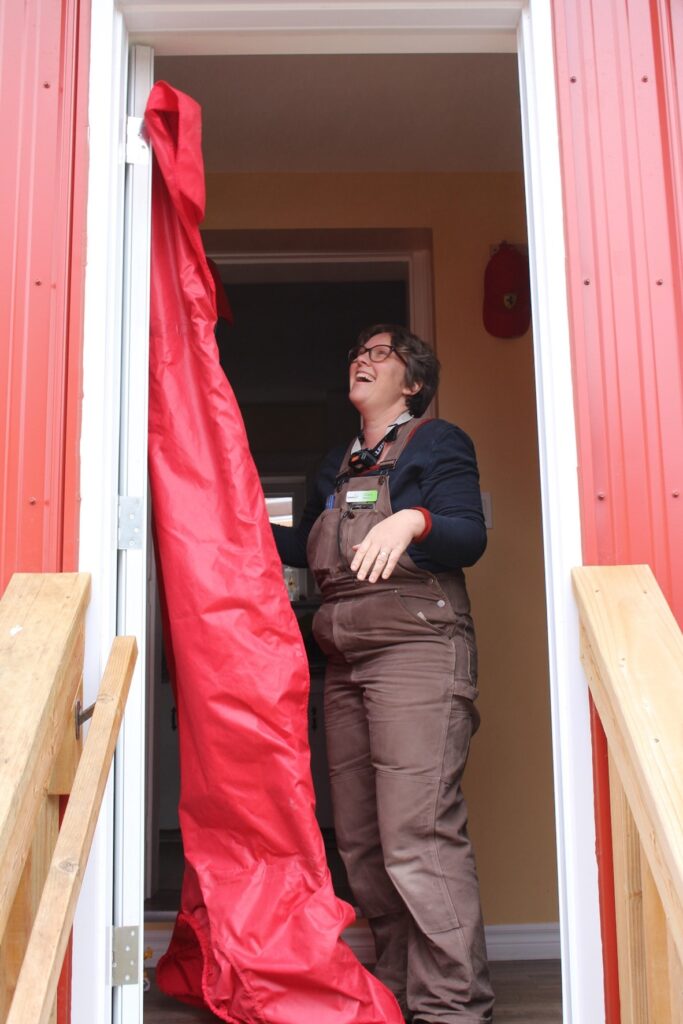
Their Energy Advisor visited for a home energy evaluation on September 27, 2021, and got to work getting measurements of all the doors and windows, and measured the exterior of the house with her laser distance meter. A blower door test was conducted to assess air leakage and identify the location of significant leaks.
Post evaluation, the homeowners received an EnerGuide label for their home, a detailed report called the “Homeowner Information Sheet”, and an equally detailed “Recommended Upgrade Report”.
The Deep Energy Retrofit
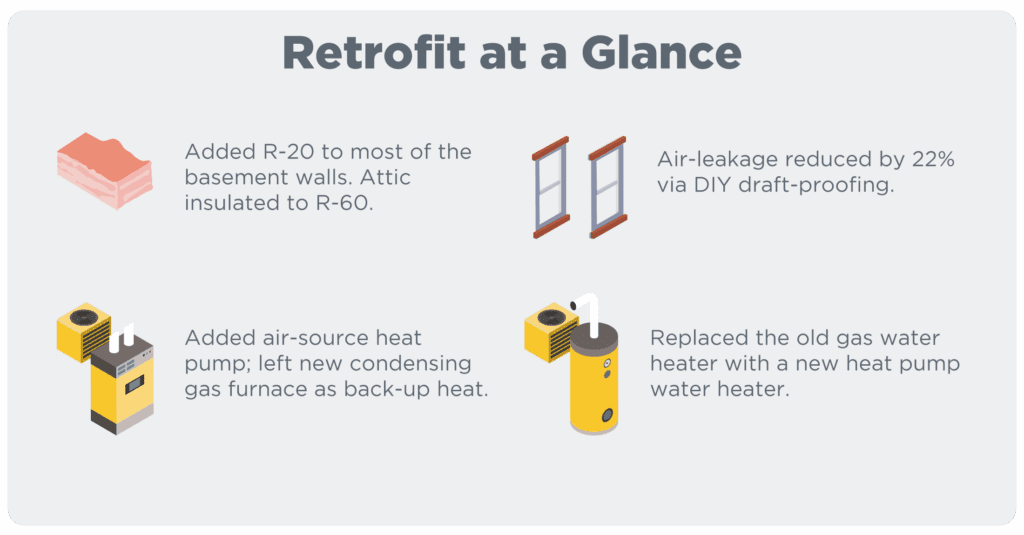
After receiving the recommendations, the Blakelocks picked up the phone to call contractors. “We didn’t have any trouble finding contractors. We already had someone redoing our kitchen, and they referred us to Home Hardware for insulation work,” said Jim.
Jim and Susan decided to start by contacting an HVAC contractor to install an air-source heat pump in their home.
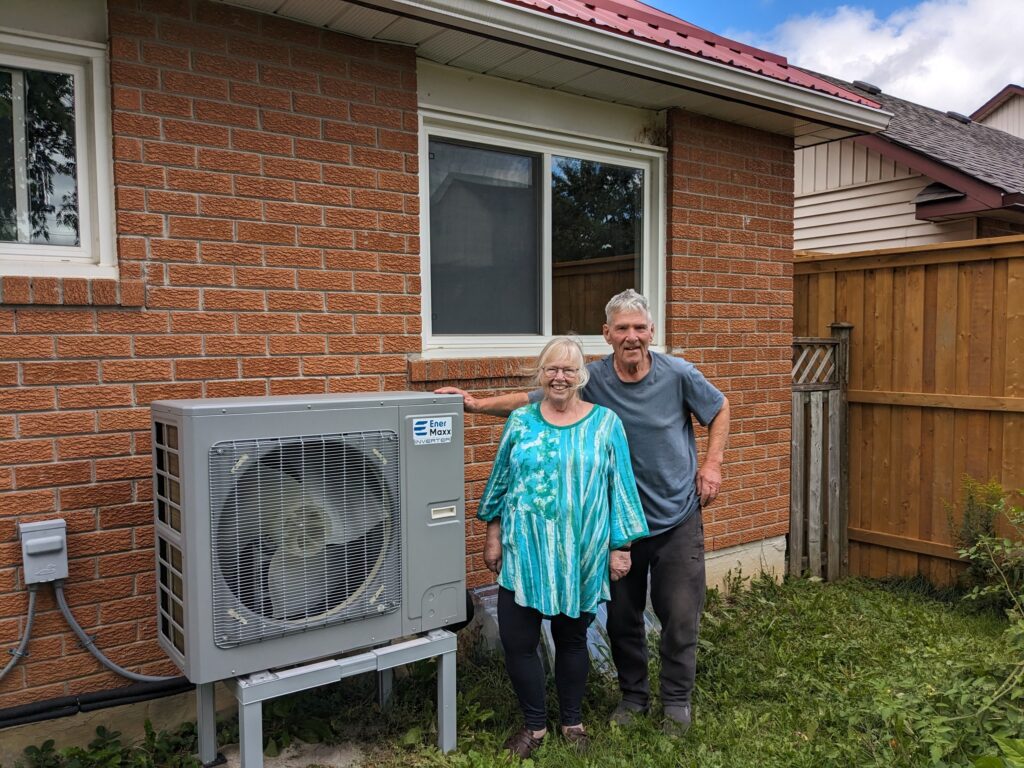
Susan and Jim noted that their advisor’s experience with a mini-split air-source heat pump in her home helped assure them that it could work in their own home, too. However, their heat pump would be a centrally ducted unit to take advantage of the existing ductwork.
The Blakelocks had an HVAC installer come by the house in December 2022. The installation cost them about $1,100, and the air-source heat pump itself was roughly $8,600. With the $4,500 heat pump rebate, the total cost for the heat pump came down from $9,700 to $5,200. Luckily, their electrical load did not require an upgrade to their electrical panel.
At the same time, the homeowners upgraded from a manual thermostat to a programmable thermostat installed by BKR Energy. Rebates are available for replacing old manual thermostats with new programmable or smart thermostats in the Canada Greener Homes Grant program, and Enbridge’s Home Efficiency Rebate Plus (HER+) program.
A few months later, in March 2023, the couple had insulation contractors come by to insulate their attic and basement. The insulation in the basement was thin and unfinished, causing significant gaps in their home’s thermal barrier. Susan added, “The (existing) insulation was only partway down, not down all the way to the ground. When the contractors did the insulation in the attic, they sealed the hatch there because it wasn’t sealed before.”
In total, insulating their attic and basement cost $5425. Jim and Susan received rebates of $800 for insulating their attic and $1,162 for insulating their basement from the Canada Greener Homes Grant. This brought the cost of insulation work down to $3,463.
Next in their deep retrofit was replacing their old gas water heater with a heat pump water heater. In April 2023, the plumbing contractor arrived at their door to install their new water heating system. This system has the benefit of a highly efficient heat pump transferring heat to the water. Heat pump water heaters use much less energy than standard electric water heaters and are far more efficient than fuel-burning water heaters. The new water heater and its installation cost a sum of $4,125.02; with a rebate of $1,300 for it, the total cost came down to $2,825.02.
Finally, the Blakelocks got busy with a bit of do-it-yourself work! They bought about $40 worth of caulking supplies to seal cracks in their home’s building envelope, identified during their blower door test.
Jim and Susan got their draft-proofing work done in May 2023. Shortly after, their energy advisor returned for a post-retrofit energy audit to evaluate how much the retrofit improved the efficiency of their home.
The Blakelocks plan to add a seven-kilowatt array of solar panels to their new metal roof to bring their energy consumption and their bungalow’s emissions down closer to net-zero. Jim and Susan have already spoken to solar contractors to schedule an initial assessment. The couple has also purchased their first electric car, which can be paired with an at-home charger that can work smartly with home batteries they might get to store surplus solar energy.
“If we were to do it again, we would’ve sat down and written out a plan for this house because this needed a whole lot of work,” Jim sighed. Both agreed that the energy audit was very useful in helping them to plan their retrofit, but added that more support would’ve helped shrink some of the hiccups they encountered.
The Retrofit’s Benefits
The Blakelocks are excited that they’re almost able to switch off their gas connection. “$40 bucks for twelve months, even if we don’t use any gas at all—just for the silly gas connection fee! Even then, we’re still saving maybe $420 off our gas bill for the year. I think we spent maybe $800-$900 on our gas bill (since moving into the house) before we did any of this,” Jim noted.
The couple agrees that the heat pump is much quieter than the furnace. “The hybrid water heater makes some noise, but you can’t hear it at all when you’re upstairs. Outside, the heat pump is way quieter than the air conditioner that was in this house when we moved in,” Jim noted. He said it works exactly as it should during the summer for cooling.
“But the house is so well-insulated now that we don’t need it that often. It’s only come on so far, like three or four times. We never had air-conditioning in our old house; we just had ceiling fans, so it’s a great treat for us to even have it now,” Susan added.
Jim and Susan also found their house significantly more comfortable after the attic and basement insulation work was completed. That building envelope work helps their new heating and cooling system to run less often, which shrinks their energy bills and relevant carbon emissions.
“When the heat pump is operating as it should, it just feels like a kinder heat. The air coming out of the register with the furnace was about 37 or 38 degrees Celsius; the air coming out with the heat pump is about 31 degrees. The heat pump tends to run a bit longer to bring the house to the set temperature, but keeps it there more consistently than with our old furnace,” said Jim.
“Caulking the windows in the basement addressed that problem for sure because, before, you could see the webs down there blowing in the breeze coming in from the cracks,” Jim relayed. With those air leaks sealed, Jim and Susan should see fewer spiders and other creepy crawlies getting into their home.
Financial Incentives and Climate Goals
In total, the Blakelocks spent $19,672.37 on their deep home energy retrofit—including the EnerGuide evaluations. They took advantage of two different rebate programs, from Enbridge Gas and NRCan. The total amount in rebates that Susan and Jim received to offset those costs was $8,820.35; this brings the grand total down to $10,852.02—just over half, at 55 per cent, of the cost of their entire deep energy retrofit project!
The couple’s energy advisor submitted their post-retrofit report to NRCan at the beginning of June; Jim and Susan then received their rebates six and eight weeks after applying.
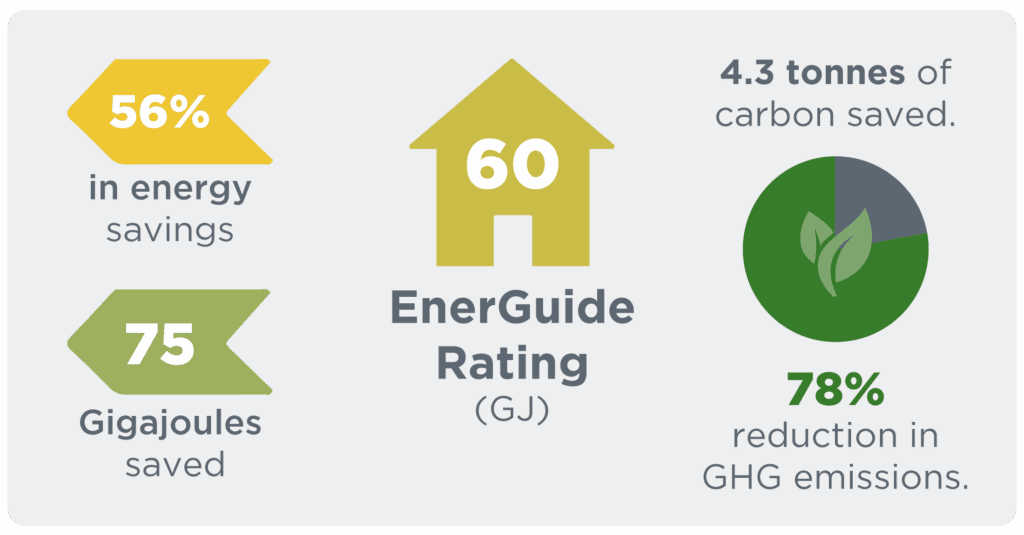
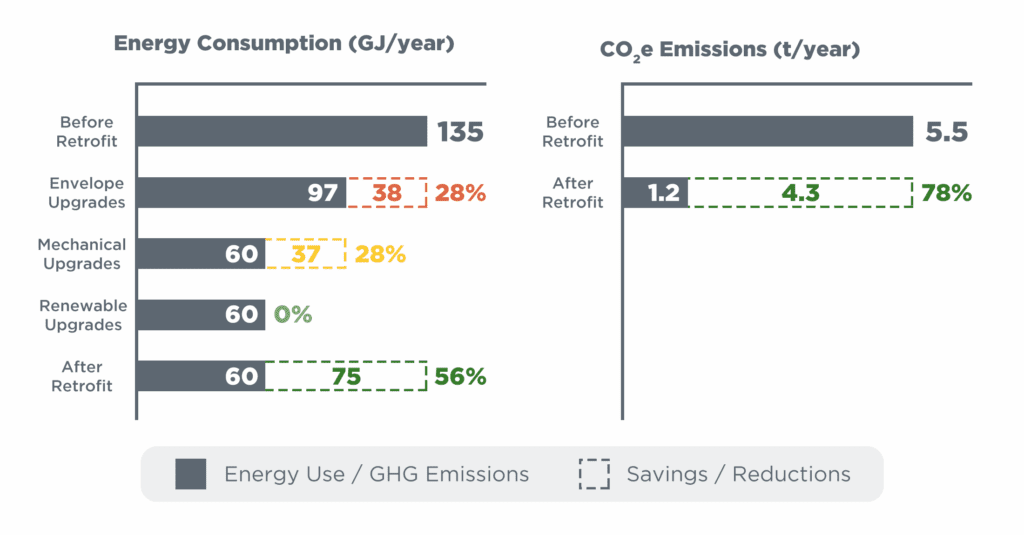
Susan and Jim hadn’t realized they had achieved over 50 per cent energy savings until they received their final report. Their eventual goal is to go net-zero in their lives because they care about the future of their grandkids. Jim expressed that he’s not just doing it for their own family, but for the next family that will live in their little red bungalow—in the spirit of “paying it forward”.
Susan mentioned that their plans to add solar came about because they’ve already lived with solar for years at their previous home in Ajax. “We tend to be early adopters for things like this, to get the ball rolling in the right direction,” Susan added.
In a serious tone, Jim noted, “When I look at the news, it just seems like we’re all trying to rearrange deck chairs on the Titanic. Whether the problem is inflation, or shortage of housing, or the price of vegetables—all of that doesn’t matter if our environment falls apart: it’ll take everything else down with it because that’s where we work, where our homes are, and how we’re able to grow all of our food in the first place.”
Key words: deep energy retrofits, home energy retrofit, EnerGuide, heat pump.