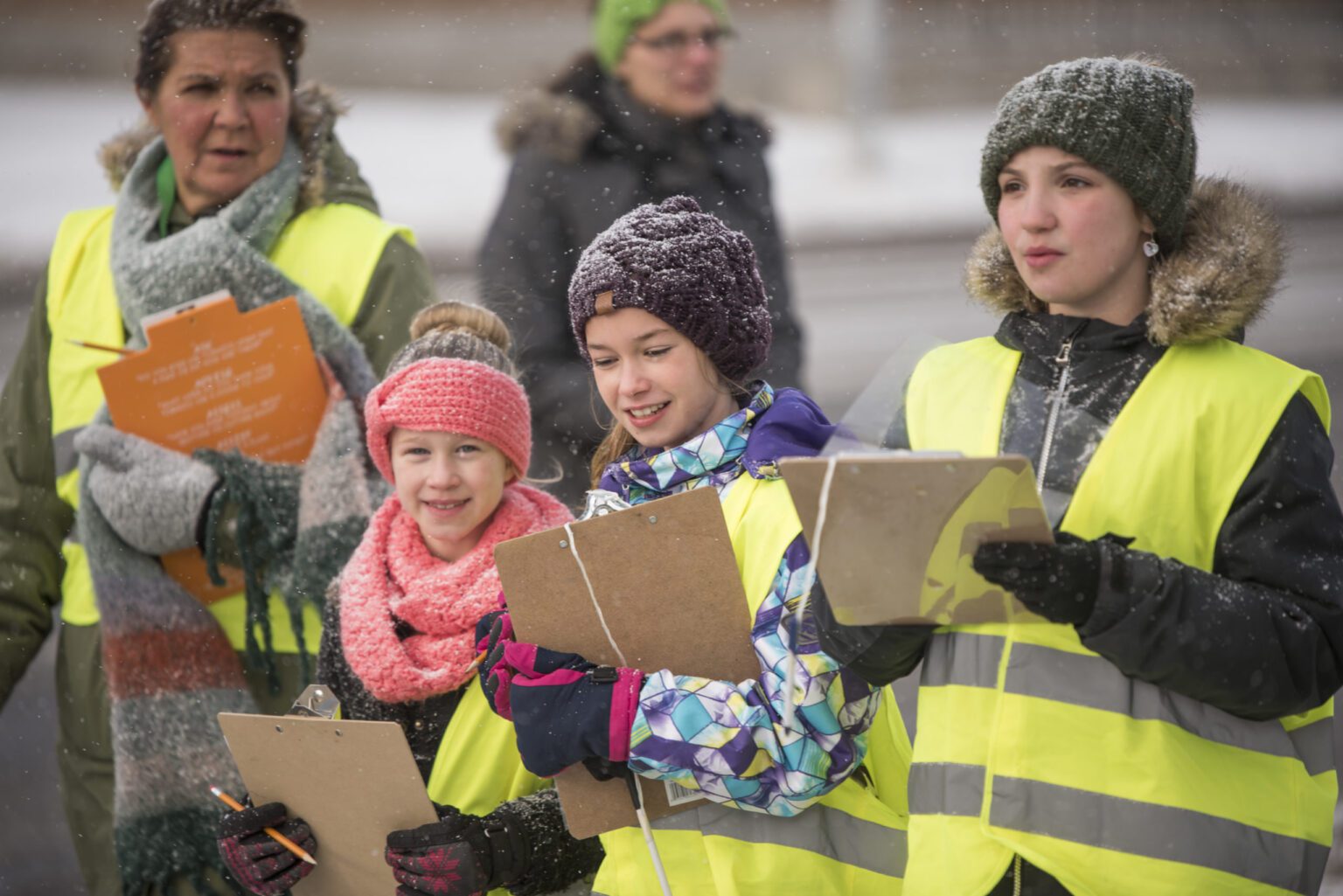
The purpose of this resource is to support the implementation of a traffic count, to gain an understanding of the types and amounts of traffic travelling to/from or past a school.
Description
Observers are positioned at select locations near the school site, focusing on paths, streets, and intersections with higher volumes of pedestrians, cyclists, and vehicles. Each observer records the types of vehicles and travel modes that pass by the observation point.
Municipalities may already hold traffic count data or be willing to conduct a traffic count for a school and share the findings, so it is worth checking options with municipal transportation staff, who often have access to automated tools that can collect data on road traffic (vehicles as well as cyclists), and sidewalk or path usage (pedestrians or cyclists).
A Traffic Count should be scheduled to coincide with the periods of peak school traffic volumes. Pick a day that is representative of normal traffic patterns (mid-week is preferred) and consider repeating the count at different times of the year to see how things change in different weather conditions.
Traffic Counts are a useful tool for measuring changes in school travel mode over time, as well as data about other traffic that moves through the school zone during busy times, such as large trucks. A count can be combined with a Traffic Observation to measure traffic behaviours in addition to counting the number of vehicles/pedestrians/cyclists.
Once the count results have been compiled, share them with the school as well as the school board and municipal staff to foster a discussion and develop solutions for the locations of concern.
What you will need
Talk to municipal transportation staff first to check for existing traffic count data. If you decide to conduct a school-led Traffic Count, you will need a team of volunteers, each with a Traffic Count sheet with a map and instructions.
Who can help
Municipal transportation staff, parents, public health nurses, and community volunteers.
Key words
Active transportation, walking, cycling, travel, trucks, driving, school bus, survey, data, evaluation, measure, vehicles, count, traffic, volume.